Rewriting the way house rules are tracked and shared.
Documenting my process for ideating and creating an app.

As an avid tabletop gamer, I love finding new games to play. At the same time, I also love taking the games I already own and finding new ways to play them, either by creating my own house rules or finding some online. The problem, though, is that there isn’t really a centralized place to do this. I decided to flesh out a concept for what a tabletop gaming mobile app centered around creating and sharing “house rules” could look and function. Since this was a solo exercise, I had to take the reins on every aspect – ideation, scope, research, and visual direction, among others.
Background
Upon looking into what is out there for rules-related board game apps, I came to the conclusion that the apps that currently exist are more geared toward the official, publisher-made rules. House rules, on the other hand, seem to only exist on discussion platforms, such as Reddit and the Board Game Geek forums. Both platforms have their merits, but can be a bit difficult when it comes to searching for information, simply due to the discussion forum format of both. I decided to pivot and start my research by looking into official rules-oriented apps. When I Googled "board game rules app," there were three results that caught my attention: Dized, Rulepop, and Tabletop Codex. Each of them seemed to have unique approaches to delivering rules-related content, so I decided to take a dive and see what each one was all about.
Competitive Review
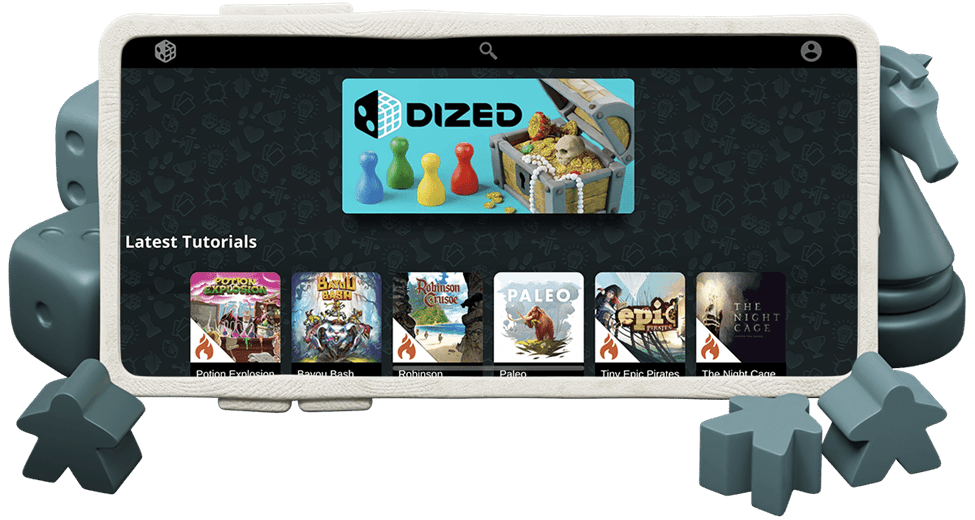
Dized is a platform that not only includes rules to various board games, but also interactive tutorials. This gives hands-on learners an opportunity to learn how to play as they go, something that has traditionally only been feasible when playing a board game with someone who has already played it. The platform also has some extras for their supported games, such as game specific scoring tools, audio soundtracks that can be used for immersion, and timers for games that require them. Overall and pretty interesting and robust application, and considering that I own a couple games that are on the platform that I have yet to play, I may be giving this one a try to see how well it works.

Rulepop is much more limited in scope than Dized, opting to instead focus specifically on rules. The site hosts and incredibly small library of games, sitting at a total of 10. Digging on the site revealed that each Rulepop sub-site is actually commissioned by the board game publishers themselves, rather than being proactively created by Rulepop themselves. The content is well written and even includes quick reference/cheat sheet material, an incredibly useful tool that isn't always included in physical games. The site seems to want to act as an "upgraded" version of the physical rulebook rather than any sort of additive companion to the already existing materials.
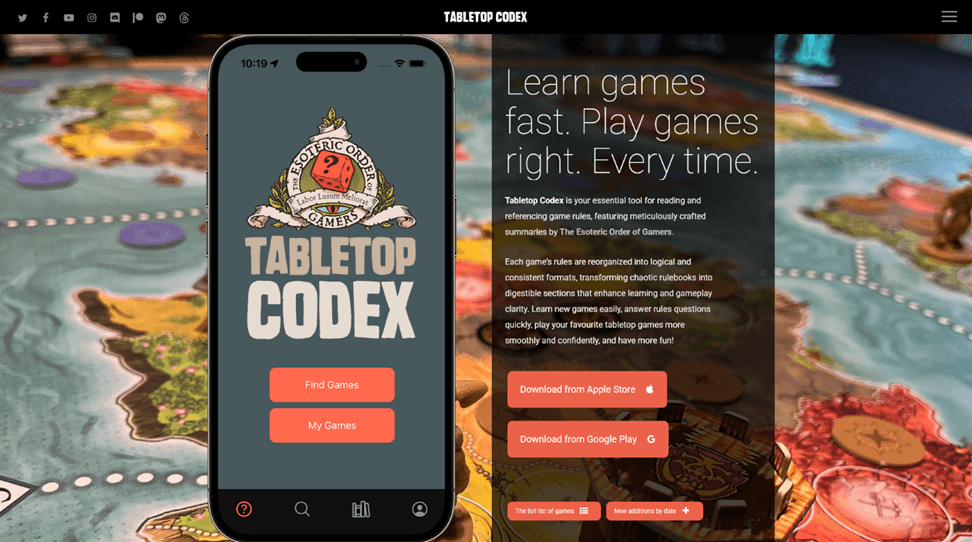
Another take on the "upgraded" rulebook, Tabletop Codex is designed exclusively to run on mobile devices and tablets, forgoing a web version altogether. While the choice does make sense, a laptop is not an uncommon sight at a game table and could potentially be preferred by certain users over a phone or tablet. The app contains rules for over 200 board games, yet all but 5 are locked behind a paywall; Users have the option of paying for the individual rulebook, or a recurring subscription that grants access to the entire library. The rulebooks are actually rewritten versions made by the app's creator, The Esoteric Order of Gamers, and are structured in such a way that is meant to be concise and digestible. Rules are broken out into sections, each accessible through an accordion; users are also able to use a search function within a rulebook, a function I know I would personally find handy when needing to quickly reference a particular rule in the middle of a game.
Personas, MoSCoW Analysis, and CTA Matrix
Determining the functions and features to explore and flesh out was the next logical step. To help me guide exploration, I came up with 3 simple personas of the type of user I thought would use and app like this. These personas cover a diverse set of individuals, from those who play short, classic board games, all the way to individuals who make board gaming their primary hobby.
Classic Carrie
Age: 27
Occupation: Accounting
Games:
Monopoly
Uno
Scrabble
Motivator(s)
Loves the classics, but wants to find fresh new ways to play them.
Experimental Eddie
Age: 30
Occupation: Developer
Games:
Catan
Wingspan
Magical Athlete
Motivator(s)
Eddie will create his own rules for his favorite games for a unique challenge, and would like to share them with the world.
Hardcore Henry
Age: 32
Occupation: Retail
Games:
Twilight Imperium
Gloomhaven
Star Wars: Rebellion
Motivator(s)
Board game night is a big deal for Henry; his group tends to stick to long-form games that take up an entire evening. While they like the games they have, they can get stale at times.
With consideration for these personas, the MoSCoW analysis came together pretty quickly. While most of the ideas I came up with seem pretty rudimentary, there were a few flourishes that I knew a first pass could do without.

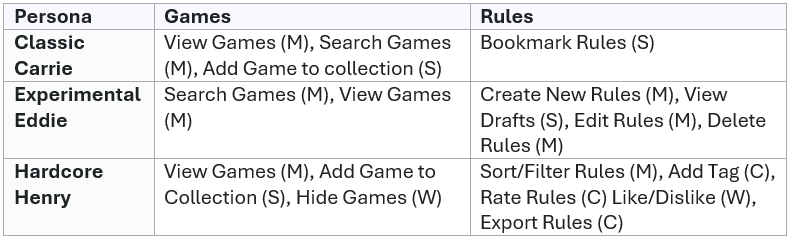
From the MoSCoW analysis, I then built a CTA Matrix to get an idea for how extensively a given persona would use the functions.
Exploration Sketches
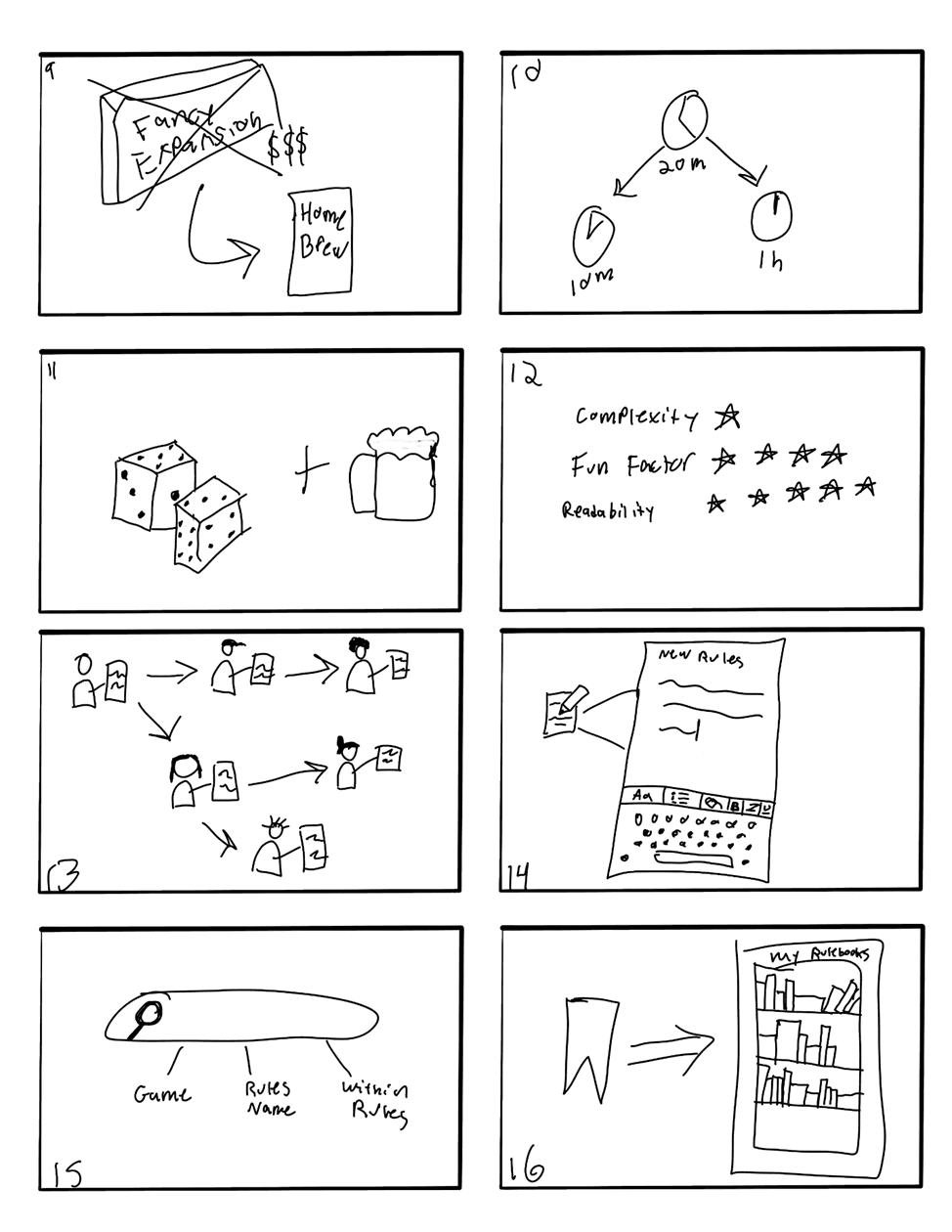
With my exploration sketches, I thought mostly about how the app could be used for various gaming needs, such as balance, difficulty modification, team play, etc. With that, I also realized that since the main driver for content on the app would be the user’s own creativity, the tools that would be baked into the app needed to have a more robust feature set to not hinder the creative process. I also realized how critical discovery within the app was; after all, what good is making something that’s meant to be shared, if people aren’t able to find it?


System Sketches
I dug deeper into three major parts of the app with my system sketches: the home screen, rules editor, and games collection.
Home Screen

I like:
Asymmetrical grids
The idea of a game table as a background
Tabs
I’d like to improve:
Use of accordions
Iconography
Info organization
Rules Editor
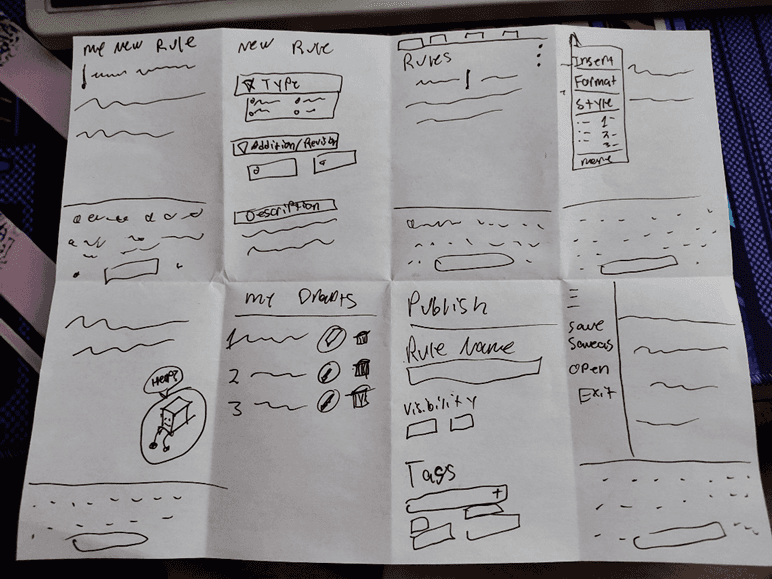
I like:
Virtual Assistant a la Clippy
Modern MS Word style layout
Pop-up options (upper right corner)
I‘d like to improve:
Form-style rules page
Publishing page layout
Drafts page
Games Collection Page

I like:
Bookshelf Display
Carousel format
Single game page
I’d like to improve:
Genre sorting page
Information order on game page
List view
Home Screen Elements & Sketches
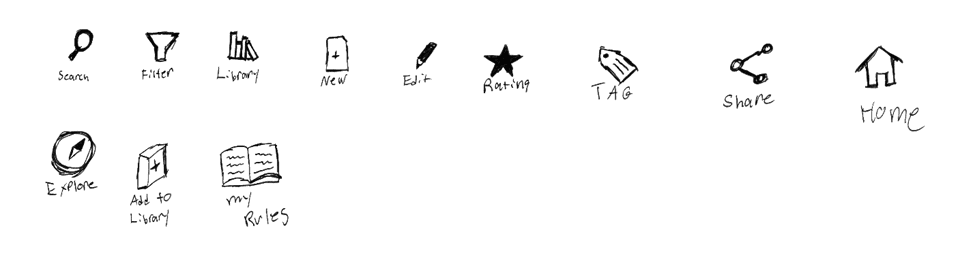
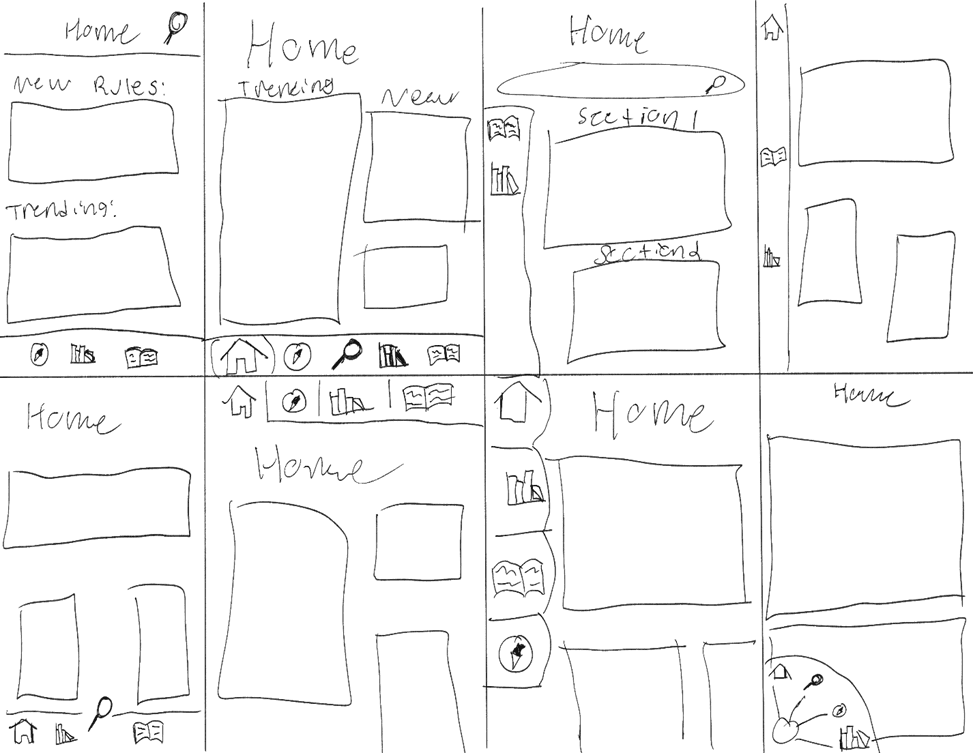
With the home screen being the first thing users see when they open the app, I wanted to do some more ideation and really nail down a layout that makes sense, so I did some more playing around with layouts, as well as defining iconography for the functions within the app.
Next Steps
With the baseline exploration complete, I’ll want to move to some paper prototype testing. I’ve refined the sketches for the Home page and Rules page, and also put together what I think a login screen should look like for the app. The tasks I’ve put together should provide some valuable feedback on both the visuals, but also help inform what the information architecture could look like as I dive deeper into the concept.
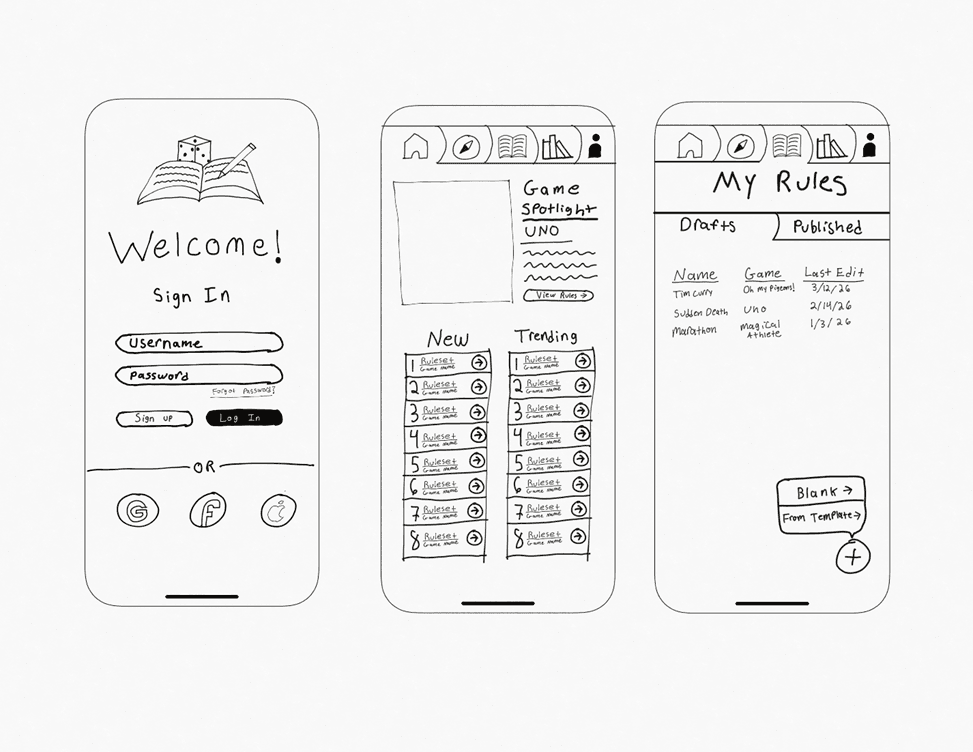
TASK 1: You’ve just downloaded the app and want to poke around real quick. You’re not a fan of creating credentials since that’s just one more password to remember. See if there’s a way you can sign in with another platform account you already have.
TASK 2: You’re planning your next board game night, and everyone has voted to play Catan. You’ve grown tired of playing the standard rules though, so you want to see if anyone has come up with new and exciting ways to play. Try to locate new rules within the app.
TASK 3: It’s been a while since you’ve worked on writing the rules for “Marathon Mode,” a custom game mode for the board game Magical Athlete. However, you’ve recently been struck with inspiration, and want to write the idea down before you forget. Edit your existing rules draft.
Conclusion
I’m really loving what I’ve developed so far with this concept. I’m definitely going to keep building on this, and possibly work towards a functional prototype that I can share with my fellow board game loving friends so I can get a stronger feel for how the social functions could operate. With tabletop gaming gaining popularity in recent years, I’d love to be able to contribute to the hobby in a way that fosters the creativity of the players.